 Ikura Cart
Tourist Model or Japan Domestic Model? Check the Exact Box
Updated 2026-10-14
Reviewed 2026-10-14
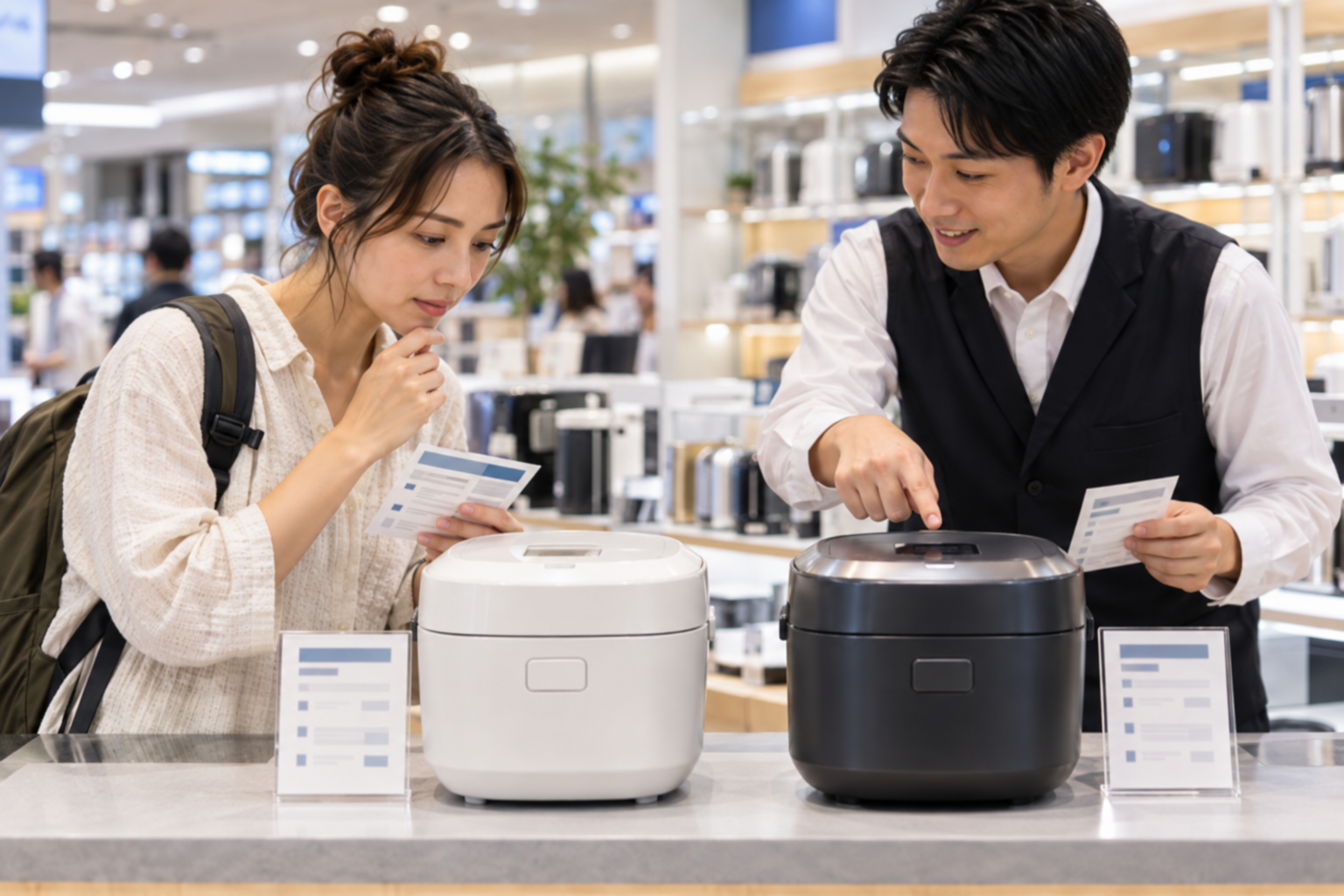
Two appliances with the same brand and a similar name can be built for different markets. A tax-free sticker only describes the sales tax procedure. It does not prove that the product accepts your power supply, speaks your language, connects to services at home, or has warranty coverage where you live.
Tourist model is a specification, not another word for tax-free
Japanese retailers may call an export-oriented product an overseas model or tourist model. The useful distinction is the full model code and the country or region written on its warranty. Some tourist models support several voltages, multilingual menus and repair in listed markets. Others are made for one particular voltage or destination. The label is a reason to inspect the details, not a promise that every country is covered.
A domestic model is designed for sale and support in Japan. It may still have a 100 to 240V power adapter, but that does not turn the whole product into an international model. Menus, radio functions, apps, cloud accounts, included plugs, spare parts and warranty can remain Japan-specific. Conversely, paying consumption tax on a tourist model does not remove its overseas specification. Tax treatment and product compatibility are separate questions.
Match the complete model code to the place you will use it
Photograph the rating plate and every suffix in the model code, then compare the manufacturer page for that exact variant. Japan runs at 100V, 50Hz in the east and 60Hz in the west. The United States and Canada run at 120V 60Hz, close enough that many 100V-only appliances still operate, though no manufacturer guarantees it. The United Kingdom, Ireland, Australia, New Zealand and Singapore run at 230V 50Hz, where a 100V-only appliance needs a real step-down transformer rated for its wattage, not a travel plug adapter that only changes the pin shape. A transformer still does not solve language, wireless approvals, an unsupported app, unavailable consumables or a warranty that requires service in Japan.
For a device with Wi-Fi, Bluetooth, an app or downloadable content, confirm that your home app store, account region and local network are supported. For a kitchen or beauty appliance, check the heating or motor specification rather than only the detachable charger. Ikura Cart can help save the Japanese product name and shelf label while you compare, but the rating plate and official model page decide compatibility.
- Full model code, including letters after the main number
- Rated input voltage, frequency and power consumption
- Plug, earth connection and supplied power cord
- Menu languages, app region and wireless functions
- Consumables, accessories and replacement parts available at home
- Warranty countries, service locations and required documents
Treat the warranty card as a country list
Do not ask only whether the product has an international warranty. Ask whether the exact model can be repaired in the country where you live, for how long, and at which authorised centre. Sony and Tiger, for example, publish coverage for certain overseas models while also noting model exclusions or service locations. A global brand name is not evidence that its local subsidiary must repair a Japanese domestic model.
Have the shop complete any required warranty card and keep the receipt, serial-number label and box until you have tested the product. JNTO recommends checking warranty and exchange terms before buying expensive electronics. If the item is defective, contacting the original shop while you are still in Japan is usually much easier than shipping it back after departure. An optional store warranty may also be valid only inside Japan, so read it separately from the manufacturer warranty.
Compare usable cost, not the shelf discount
Build the comparison from the tax-inclusive or eligible tax-free price, card conversion, necessary plug or approved transformer, checked-baggage cost and any home-country import charge. Then price the risk that local service refuses the model. A cheaper domestic unit can become the expensive choice if it needs round-trip shipping to Japan or cannot use a regional app.
The safer purchase is often the variant whose exact specifications and service route you can verify in writing, even if another box looks cheaper. Before paying, ask the clerk to write down the complete model code, supported destination and warranty counter. Open and inspect only as the store permits, retain every accessory, and test the device before leaving Japan.
FAQ
Does tax-free mean the electronics have an international warranty?
No. Tax-free describes the consumption-tax transaction. Warranty coverage comes from the exact manufacturer warranty and model, and may be limited to Japan or to named countries and service centres.
If the adapter says 100 to 240V, is the Japanese model safe to buy?
That confirms only the adapter's input range. Also check the product input, frequency, plug and earth requirements, menu language, apps, wireless functions, accessories and warranty for your market.
Is a tourist model always better than a domestic model?
No. It is better only when that exact variant supports where and how you will use it. Tourist models can differ by destination, features, language and service coverage.
What should I photograph before leaving the store?
Capture the complete model code, rating plate, warranty coverage, serial-number area, receipt and return policy. Avoid relying on a shelf card that may describe a nearby variant.
Official sources
- JNTO: shopping advice for checking warranties and exchanges
- JNTO: plugs and electricity in Japan
- National Consumer Affairs Center: Japanese appliance may not work overseas
- Panasonic: Tourist Model product range and service information
- Panasonic Store Plus: domestic products and domestic-only warranty
- Tiger: guidance for overseas specification Tourist Models
- Sony: Overseas Models and warranty service information
- Sony Store: overseas models for visitors and warranty scope
- MUJI Japan: domestic appliance voltage and warranty limits