 Ikura Cart
Will Electronics Bought in Japan Work at Home?
Updated 2026-09-21
Reviewed 2026-09-21
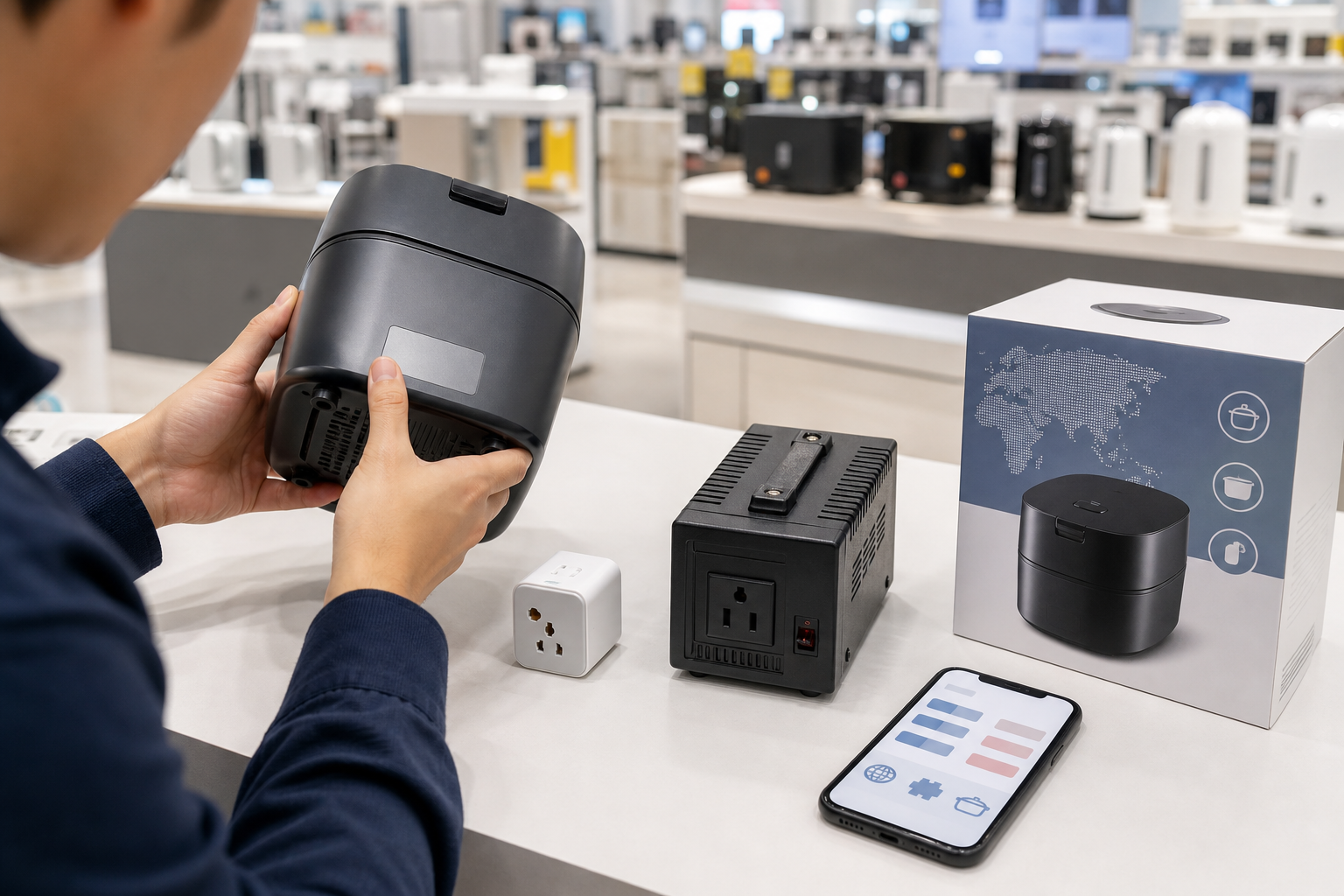
A Japanese plug that fits your wall is not proof that the appliance is compatible. Before paying, read the exact model's input label and separate four questions: voltage, frequency, plug and warranty.
Start with the rating plate, not the plug shape
Japan supplies 100V AC. Eastern Japan mainly uses 50Hz and western Japan mainly uses 60Hz. A product marked INPUT 100-240V 50/60Hz covers those electrical ranges and many overseas systems, although you may still need a safe plug adapter or a different approved power cord for the destination.
If the label says only AC100V, do not treat it as worldwide equipment. A travel plug adapter changes the pin shape only. It does not turn 220V or 240V into 100V. Even when Japan and your destination use similar flat pins, the voltage printed on the appliance remains the controlling limit.
- Photograph the model number and the complete INPUT or rated-voltage label
- Check both voltage and Hz, not just whether the plug fits
- Read the appliance label and the detachable power supply separately
- Confirm grounding and the destination plug with the manufacturer or an authorized seller
A transformer is not an automatic fix
A suitable step-down transformer can change a higher supply voltage to 100V, but it normally does not change frequency. Its continuous capacity must also suit the appliance, including any startup demand. Hair dryers, kettles, rice cookers, heaters and motor-driven products can require large, heavy equipment or may be excluded by the manufacturer even when a transformer appears powerful enough.
Do not calculate from the purchase price or appliance size. Check the watts or amps on the rating plate and the manual, then ask the manufacturer whether that exact model may be used through a transformer in your destination. If the answer is unclear, choose an overseas-specification model or buy the local model at home.
Use your destination as the final test
The United States and Canada nominally supply 120V at 60Hz, the United Kingdom and Ireland 230V at 50Hz, Australia and New Zealand 230V at 50Hz, and Singapore 230V at 50Hz. These figures explain why one Japanese model can have a different answer for each reader. They do not replace the local safety rules or the range printed on the product.
North American readers need particular care because a Japanese two-pin plug fits a US or Canadian socket with no adapter at all. A 100V-only marking still does not include 120V, and heating or motor-driven appliances may run hotter than they were designed to. In the UK, Ireland, Australia, New Zealand and Singapore the plug will not fit, which is a useful warning: a 100V-only appliance connected to 230V through a simple plug adapter can be destroyed at once and may be dangerous.
Check service coverage before claiming the bargain
A Japan domestic model may have a Japan-only warranty, Japanese controls or a power cord approved only for the Japanese market. Tourist or overseas-specification models are designed for other electrical systems, but their warranty still covers only listed products and service regions. Ask for the actual warranty document rather than relying on an international-looking box.
Before checkout, photograph the model suffix, rating plate, included cord and warranty terms. Add the cost and weight of any approved transformer, plug, replacement cord and possible return trip to your comparison. Ikura Cart can help record the shelf price and identify specification text, but the manufacturer's manual and destination safety authority decide whether the appliance is suitable.
FAQ
Does 100-240V 50/60Hz mean I only need a plug adapter?
The stated voltage and frequency ranges are compatible, but you must still confirm the destination plug, grounding, power cord rating and manufacturer instructions.
Can I plug a 100V Japanese appliance into a 110V or 120V outlet?
Do not assume so merely because the difference looks small or the pins fit. If 110V or 120V is outside the printed range, obtain approval for that exact model from the manufacturer.
Will a voltage transformer also change 50Hz to 60Hz?
A normal travel transformer changes voltage, not frequency. A frequency-sensitive appliance must list the destination Hz or have specific manufacturer guidance.
Is a tax-free Japanese appliance automatically covered by an international warranty?
No. Tax treatment and warranty coverage are separate. Check whether the exact model is a domestic or Tourist Model and which service regions appear in its warranty.
Official sources
- JNTO: Plugs and electricity in Japan
- Kashimura: How to choose a transformer and plug adapter
- Panasonic: Typical electrical conditions by country and region
- Sony Support: Domestic models, power cords and overseas warranty limits
- Panasonic: Tourist Model service locations
- Panasonic: Overseas use guidance for hair dryers
- Tiger: Guidance for overseas specification Tourist Models
- China National Development and Reform Commission: Electricity supply rules
- Taiwan Bureau of Standards, Metrology and Inspection: 100V 50Hz appliance guidance
- Hong Kong EMSD: Electrical appliance buying and safety guidance