 Ikura Cart
How to Read Japanese Supermarket Discount Stickers
Updated 2026-09-28
Reviewed 2026-09-28
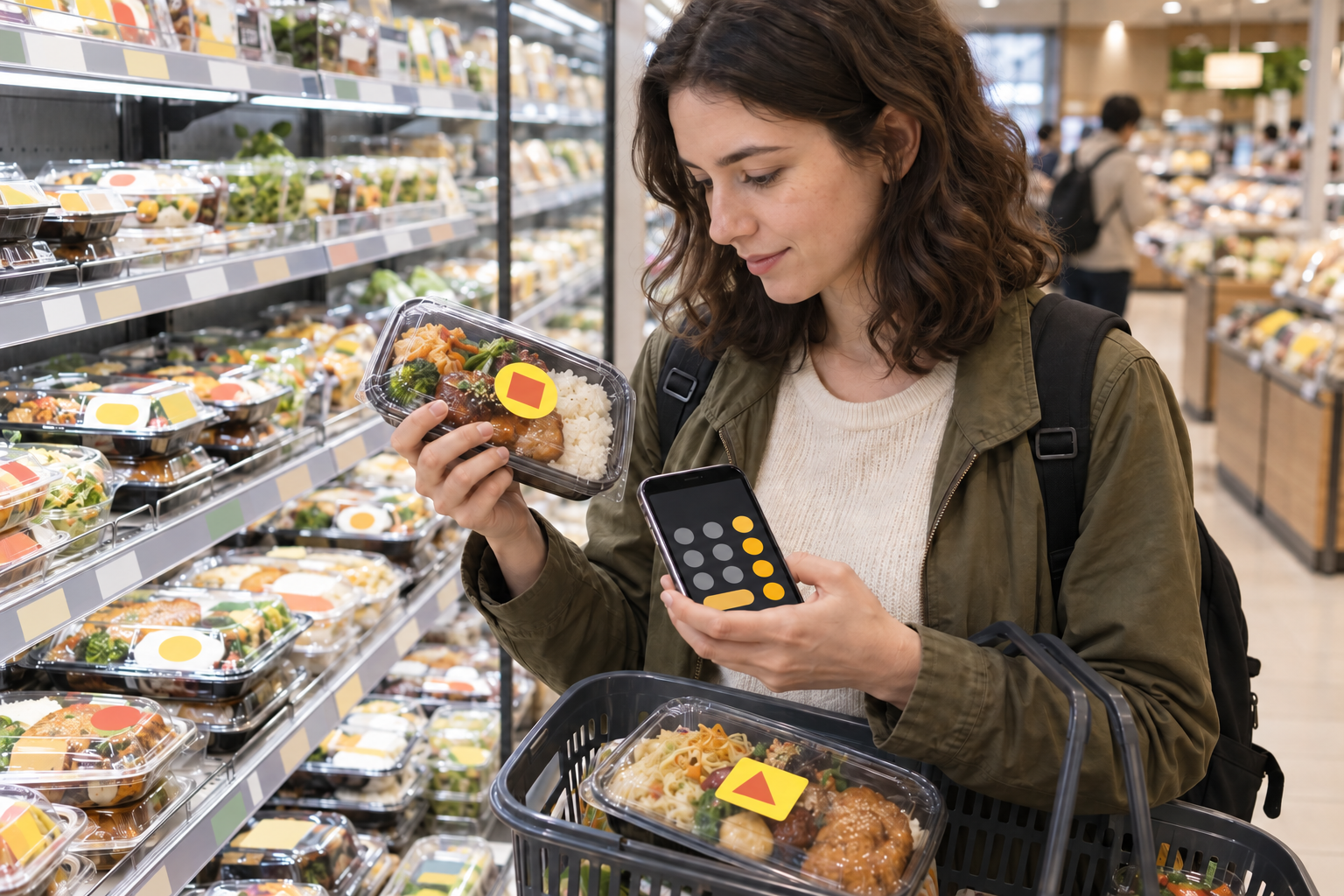
A markdown sticker can turn a supermarket bento into an inexpensive dinner, but the large number is not always the price you pay. It may show a percentage off, a fixed yen reduction or the final price. Read the Japanese word beside the number, calculate from the displayed store price, then check when and how the food must be stored.
Tell half price, percentage off and yen off apart
半額 means half price. 20%引 means subtract 20 percent, so you pay 80 percent. 2割引 says the same thing because one 割 is 10 percent. By contrast, 100円引 means subtract exactly ¥100. The character 引 signals a reduction, while 値引 or 値下げ simply tells you the item has been marked down. A sticker with 税込 and one clear amount may already show the final tax-inclusive price.
Use the amount that the shop presents as the current original price. A ¥598 bento with 20%引 is about ¥478 before the register applies its rounding rule. The same bento with 100円引 is ¥498, and 半額 is ¥299. If that ¥598 is the pre-tax 本体価格, the 8% consumption tax on takeaway food is added after the discount, so 20%引 comes to about ¥517, not ¥478. Readers from the UK, Ireland, Australia, New Zealand or Singapore, where shelf prices already include VAT or GST, are the likeliest to miss this; for US and Canadian readers it works like sales tax added at the register. Japanese tax guidance allows stores to handle fractions below one yen in different ways, so treat a hand calculation as an estimate and confirm the receipt.
Do not use sticker colour or a universal discount hour
Yellow, red and green labels are store designs, not a nationwide code. Current convenience-store programs show the variation: FamilyMart uses fixed-yen markdown labels for selected prepared foods, while 7-Eleven's Eco-da-ne label identifies eligible food approaching its sales deadline. Read the amount and unit printed on the individual item instead of assuming every bright sticker means 50 percent off.
There is no official nationwide half-price time. A store decides what to mark down according to stock, product condition, sales deadline and closing schedule. Evening discounts are common on prepared food, but waiting for another sticker can mean losing the item, and staff do not owe a further reduction. Buy only when the price, eating time and storage plan already work for you.
Check the date and cold chain before the saving
A markdown does not extend 消費期限, the use-by date for quickly perishable food, or 賞味期限, the best-before date for quality. Both dates assume the unopened product is stored as directed. If you will eat the bento or sushi after the use-by time, leave it. A cheaper product is not a saving when it cannot fit your meal plan.
Buy chilled prepared food near the end of the shopping trip, return to the hotel promptly and follow 要冷蔵 or the stated storage instruction. Japan's health ministry advises buying temperature-sensitive food last and avoiding long periods at room temperature. Tokyo's food-safety guidance also says to ask the shop about the eating deadline when no clear label is provided.
Verify the register price without holding up checkout
Leave every sticker on its original package and present the barcode side clearly. Some markdown labels contain their own barcode, while other stores apply the reduction through the register. If the amount looks wrong, compare the product line and discount line on the receipt and politely show the item to staff before leaving. Do not move a sticker between packages or assume a shelf sign covers nearby products.
For several items, calculate each reduction separately before adding the basket total. Ikura Cart can help identify the product and keep a running yen total, but the store's register and receipt are the final record. This article was reviewed on September 28, 2026 against Japanese tax, consumer, food-safety and retailer sources.
FAQ
What does 半額 mean on Japanese food?
It means half price. You pay 50 percent of the applicable original price, subject to the store's yen rounding at the register.
Is 2割引 the same as 20% off?
Yes. One 割 is 10 percent, so 2割引 subtracts 20 percent and leaves 80 percent to pay.
What time do Japanese supermarkets put on half-price stickers?
There is no nationwide time. Each store changes markdown timing according to stock, sales deadlines, staffing and closing time.
Does a discount sticker change the use-by date?
No. Read the original 消費期限 or 賞味期限 and storage instruction. The markdown changes the price, not the safe handling window.
Official sources
- Japan National Tax Agency: Consumer Price Display and Time-Service Discounts
- Consumer Affairs Agency: Food Loss Reduction Experiment in Supermarkets
- Consumer Affairs Agency: Food Expiration Date Information
- Consumer Affairs Agency: Food Loss Guidebook
- Ministry of Agriculture, Forestry and Fisheries: Everyday Food Loss Reduction
- Ministry of Health, Labour and Welfare: Food Poisoning Prevention at Home
- Tokyo Metropolitan Government: Takeaway Food Safety FAQ
- FamilyMart: Store Markdown and Food Loss Program
- 7-Eleven Japan: Eco-da-ne Markdown Labels