 Ikura Cart
What Class 1, 2 and 3 Mean at a Japanese Drugstore
Updated 2026-09-21
Reviewed 2026-09-21
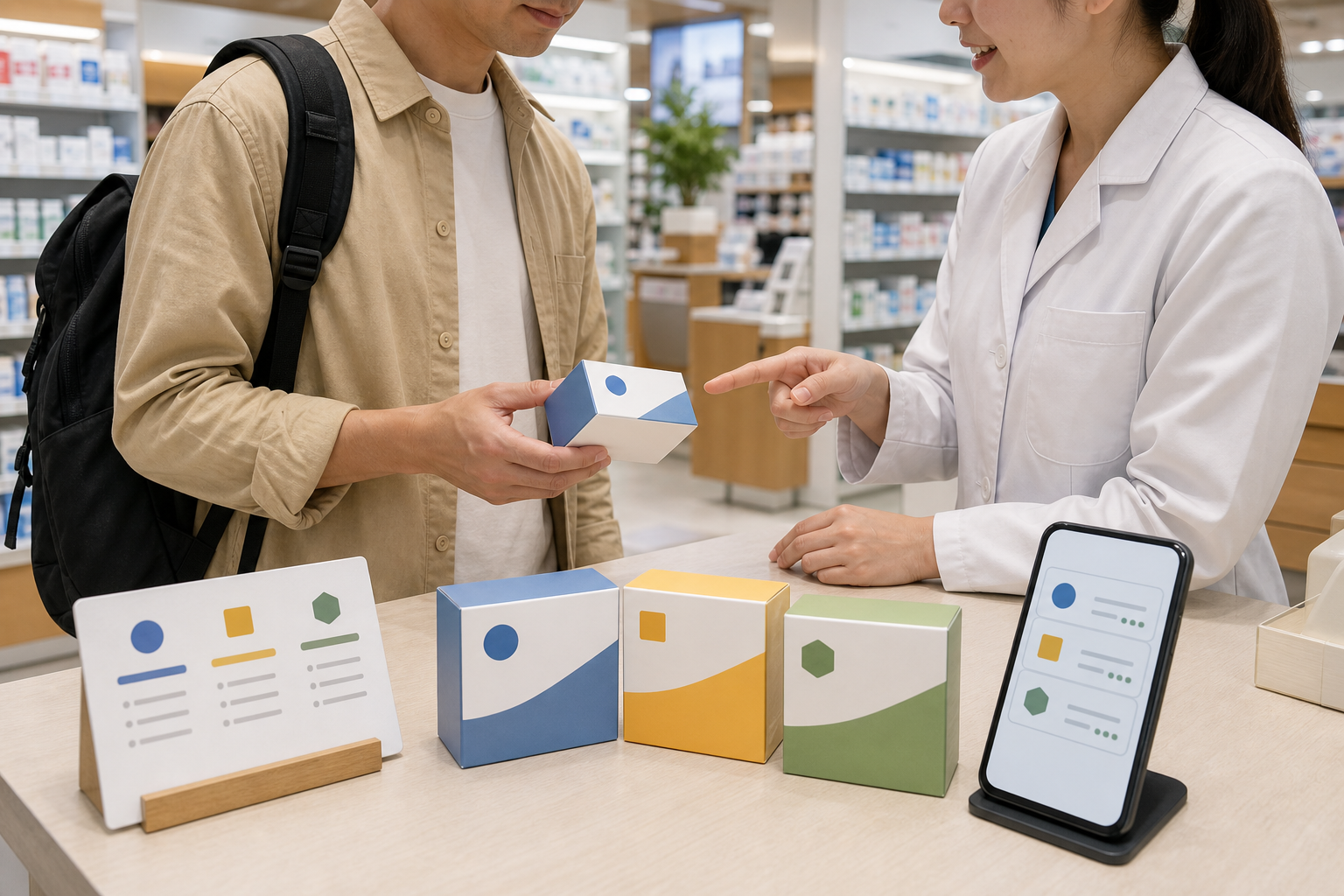
The number on a Japanese medicine box is a safety and sales category, not a score for how powerful the product is. It tells you who may sell it, how much information the seller must provide and whether you can reach it yourself. A separate rule may also trigger questions at checkout, even when the box is Class 2 or Class 3.
Read the category before comparing products
Japan separates nonprescription medicines into 要指導医薬品, guidance-required medicines, and general OTC medicines marked 第1類医薬品, 第2類医薬品 or 第3類医薬品. The category reflects risks such as adverse reactions and interactions, plus the information required at sale. It does not prove that Class 1 works better than Class 3 for your symptom.
A boxed or circled 2 marks 指定第2類医薬品, a subset of Class 2 needing particular care. This does not turn it into Class 1, but it is a good reason to ask the pharmacist or registered seller about contraindications, age limits, drowsiness and overlap with medicines you already take.
- 要指導医薬品: pharmacist guidance is required before sale
- Class 1: only a pharmacist may sell it and written information is required
- Class 2 and designated Class 2: pharmacist or registered seller; information is recommended
- Class 3: pharmacist or registered seller; the lowest risk tier in this system
A staffed store may still be unable to sell Class 1
A registered seller, shown as 登録販売者, may handle Class 2 and Class 3 products but not guidance-required or Class 1 medicines. If the pharmacist has finished their shift, the shop can remain open while the Class 1 counter is closed. A shelf card or empty display may therefore mean ask at the counter, not sold out.
Show the package photo or product name and ask 薬剤師はいますか if the label says Class 1. Expect questions about the intended user, age, symptoms, allergies, pregnancy, medical conditions and other medicines. The pharmacist may decline a sale if the answers do not support safe use. A prescription medicine is a different category and normally requires a Japanese clinician's prescription.
Some products get extra checks from May 1, 2026
Japan now labels medicines containing specified ingredients as 指定濫用防止医薬品, designated abuse-prevention medicines. The rule cuts across the Class 1, 2 and 3 system. Cold, cough, allergy or sleep-related packaging may be subject to it, so do not predict the checkout process from the class number alone.
A pharmacist or registered seller must confirm matters such as age, other medicines being used, recent purchases of the same designated products and the reason for a large pack or multiple packs. A customer under 18 may be asked for a name and proof of age, and cannot be sold a large-capacity product or multiple packs. Adults can also be refused extra quantities when appropriate use cannot be confirmed. These are safety checks, not a tourist surcharge or tax-free condition.
Check the user and ingredients before the price
Do not shop only by brand, popularity or the symptom picture on the front. Photograph the front and ingredient panel, identify who will actually use it, then tell the qualified seller about age, allergies, pregnancy, chronic conditions and every medicine or supplement currently used. Read the enclosed insert before taking it. PMDA's official database lets you search current Japanese package inserts by product or ingredient. Many visitors reach this counter because of what they could not pack. Japan's Narcotics Control Department says amphetamine-based ADHD medicines such as Adderall cannot be brought in even for treatment, and it lists pseudoephedrine among stimulants' raw materials and codeine among narcotics, both of which need permission before you travel. For other medicines, the Ministry of Health, Labour and Welfare allows up to a one-month supply of prescription drugs and a two-month supply of ordinary ones without an Import Confirmation (輸入確認書, Yunyu Kakunin-sho). Whether a particular decongestant or cough tablet from home falls under those controls depends on the product, so ask the department before you fly and do not guess. At the shelf, read the active ingredient in katakana: アセトアミノフェン is acetaminophen, the paracetamol of UK, Irish and Australian pharmacies, イブプロフェン is ibuprofen and ロキソプロフェン is loxoprofen.
Stop self-selection and seek medical help for severe symptoms, breathing difficulty, altered consciousness, signs of a serious allergic reaction or symptoms that persist or worsen. Ikura Cart can help you keep track of a shelf price and identify product text while shopping, but it cannot decide whether a medicine is safe for you. The package insert and advice from a pharmacist, registered seller or clinician take priority.
FAQ
Is Class 1 medicine the strongest medicine in Japan?
No. The number is a risk and sales-information category. It does not rank products by effectiveness for your symptom.
Can I buy Class 1 medicine when no pharmacist is present?
No. Only a pharmacist may sell Class 1 medicine. The drugstore may stay open while that category is temporarily unavailable.
Why did the cashier ask my age and whether I bought medicine elsewhere?
The product may be a designated abuse-prevention medicine. Since May 1, 2026, sellers must make additional checks that can include age, other medicines, recent purchases and the reason for extra quantity.
Does tax-free eligibility mean I can take the medicine into my country?
No. Japanese retail and tax-free rules do not override the rules at home. Some Japanese cold and cough remedies contain codeine, dihydrocodeine, ephedrine-type ingredients or pseudoephedrine, which Japan itself designates as abuse-prevention ingredients and which may be controlled where you live. Before packing them, check the FDA and US Customs and Border Protection if you live in the US, the UK government's guidance on travelling with controlled drugs, which Border Force enforces, or Australia's Therapeutic Goods Administration and the Australian Border Force.
Official sources
- Japan Ministry of Health, Labour and Welfare: Pharmaceutical sales system and current classifications
- Japan Ministry of Health, Labour and Welfare: 2025 Pharmaceutical and Medical Device Act amendments
- Japan Ministry of Health, Labour and Welfare: Rules for designated abuse-prevention medicines from May 2026
- Japan Ministry of Health, Labour and Welfare: Designated ingredients effective May 2026
- PMDA: Search official package inserts for OTC and guidance-required medicines
- Japan Self-Medication Industry: OTC categories and qualified sellers
- Tokyo Metropolitan Government: How to buy and use OTC medicines safely
- Shiga Prefecture: Current OTC categories and sales rules from May 2026
- JNTO: For safe travels in Japan multilingual medical guide
- Daiichi Sankyo Healthcare: Pharmacists and registered sellers at drugstores
- Japan Ministry of Health, Labour and Welfare: Bringing medicines for personal use into Japan
- Japan Narcotics Control Department: Bringing controlled medicines into Japan
- US Customs and Border Protection: Prohibited and restricted items, traveling with medication
- GOV.UK: Travelling with medicine containing a controlled drug