 Ikura Cart
Can You Take a Power Bank Bought in Japan on the Plane?
Updated 2026-10-07
Reviewed 2026-10-07
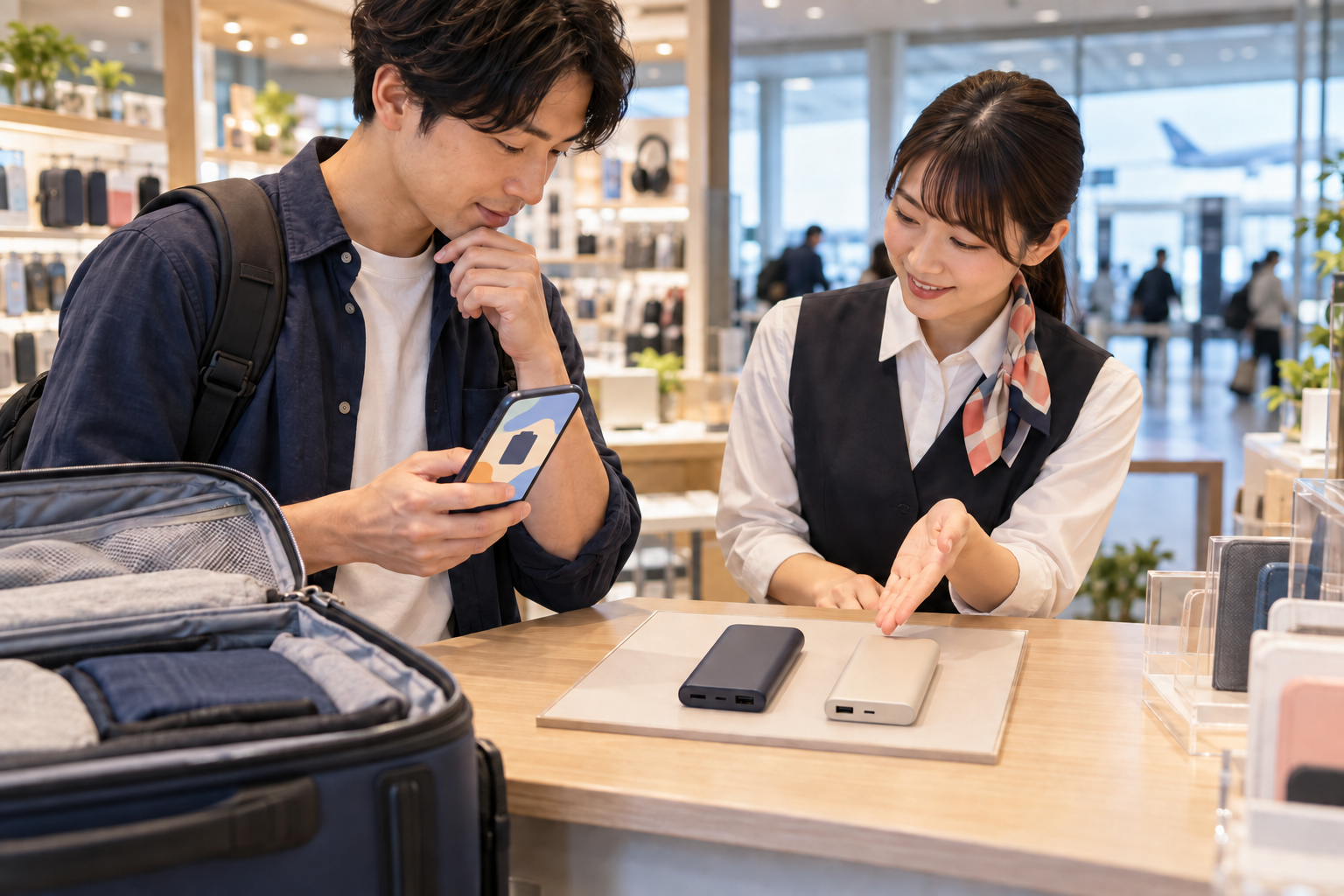
A power bank can be legal to sell in Japan and still be awkward to fly with. Since April 24, 2026, Japanese rules limit each passenger to two power banks, each rated at no more than 160Wh. They belong in the cabin, cannot be checked, and must not be charged or used to charge another device onboard. The safest shopping decision starts with the tiny rating label, not the capacity printed largest on the box.
Read Wh first, then calculate only if needed
Look for a clearly printed watt-hour rating marked Wh on the device itself. If only nominal voltage and capacity are shown, calculate Wh = mAh × V ÷ 1,000. A 10,000mAh bank rated at 3.7V is 37Wh, while a 20,000mAh model at 3.7V is 74Wh. Use the nominal battery voltage on the rating label, not a 5V, 9V or 20V USB output profile.
Do not substitute a web estimate when the casing is unreadable. IATA tells passengers to check the rating printed on the battery and confirm with the airline. A clear label matters again at security, so photograph it after purchase and avoid covering it with a sticker or case. Ikura Cart can record the Japanese product name, price and stated capacity, but the physical battery label remains the evidence an airline can inspect.
Apply the 100Wh and 160Wh decision points
Up to 100Wh is the straightforward category under general airline guidance. Above 100Wh and up to 160Wh may require the operating airline's advance approval. Anything above 160Wh is not accepted as ordinary passenger baggage. Japan's 2026 ceiling of two power banks does not remove an airline's approval process or a stricter rule on an international itinerary.
Count every power bank you will carry, including a battery built into a charging case or smart bag when its main purpose is to charge other devices. Airlines may also add their own limits on other lithium batteries you carry, so check the operating carrier for every segment, especially a codeshare or onward domestic flight.
Shop for a readable label, not just fast charging
Japan requires regulated lithium-ion products sold there to display the PSE mark after the supplier meets the applicable safety duties. Check the PSE mark, supplier information, model, Wh or enough data to calculate it, and recall status. The PSE mark concerns sale and product safety in Japan; it is not airline approval and does not guarantee acceptance at security abroad.
Reject a unit that is swollen, cracked, unusually hot, recalled or missing a legible rating. Keep the receipt and original packaging until the trip ends. If you need only phone backup, a clearly marked model below 100Wh usually avoids the approval question, but no capacity or brand can override the two-unit limit on a Japan-regulated flight.
Pack it where you can remove and monitor it
Put each power bank in cabin baggage and protect its terminals from metal objects. Use the retail package, a separate pouch or bag, or terminal tape as your airline instructs. Never leave it in a suitcase being checked. If staff take your cabin bag at the gate, remove the power banks before the bag goes into the hold.
On Japanese airlines, do not charge the bank from a seat outlet and do not use it to charge a phone during the flight. Keep it accessible, follow the crew's storage instruction, and report heat, odor, smoke, damage or swelling immediately. Rules at your home or connecting airport can be equally strict, so recheck the final operating airline shortly before departure.
FAQ
How many power banks can I take on a flight from Japan in 2026?
Japan limits each passenger to two power banks, each no more than 160Wh, from April 24, 2026. Your airline may impose a stricter rule or require approval above 100Wh.
Is a 20,000mAh power bank under 100Wh?
At a nominal 3.7V, 20,000mAh calculates to 74Wh. Use the actual nominal voltage and rating printed on your device rather than assuming every model is identical.
Can I put a new unopened power bank in checked luggage?
No. New, sealed and duty-free purchases are still power banks and must travel in cabin baggage with short-circuit protection.
Does a Japanese PSE mark mean the airline must accept it?
No. PSE is a Japanese product-safety and sales marking. The airline still applies its capacity, quantity, condition, labeling and approval rules.
Official sources
- Japan MLIT: New onboard power bank rules from April 24, 2026
- JNTO: New carry-on power bank regulations
- JAL: Power bank handling from April 24, 2026
- ANA: Power bank handling and terminal protection
- IATA: Safe travel with lithium batteries
- Japan METI: Choosing lithium-ion products and checking the PSE mark