 Ikura Cart
How to Read a Japanese Nutrition Label
Updated 2026-09-21
Reviewed 2026-09-21
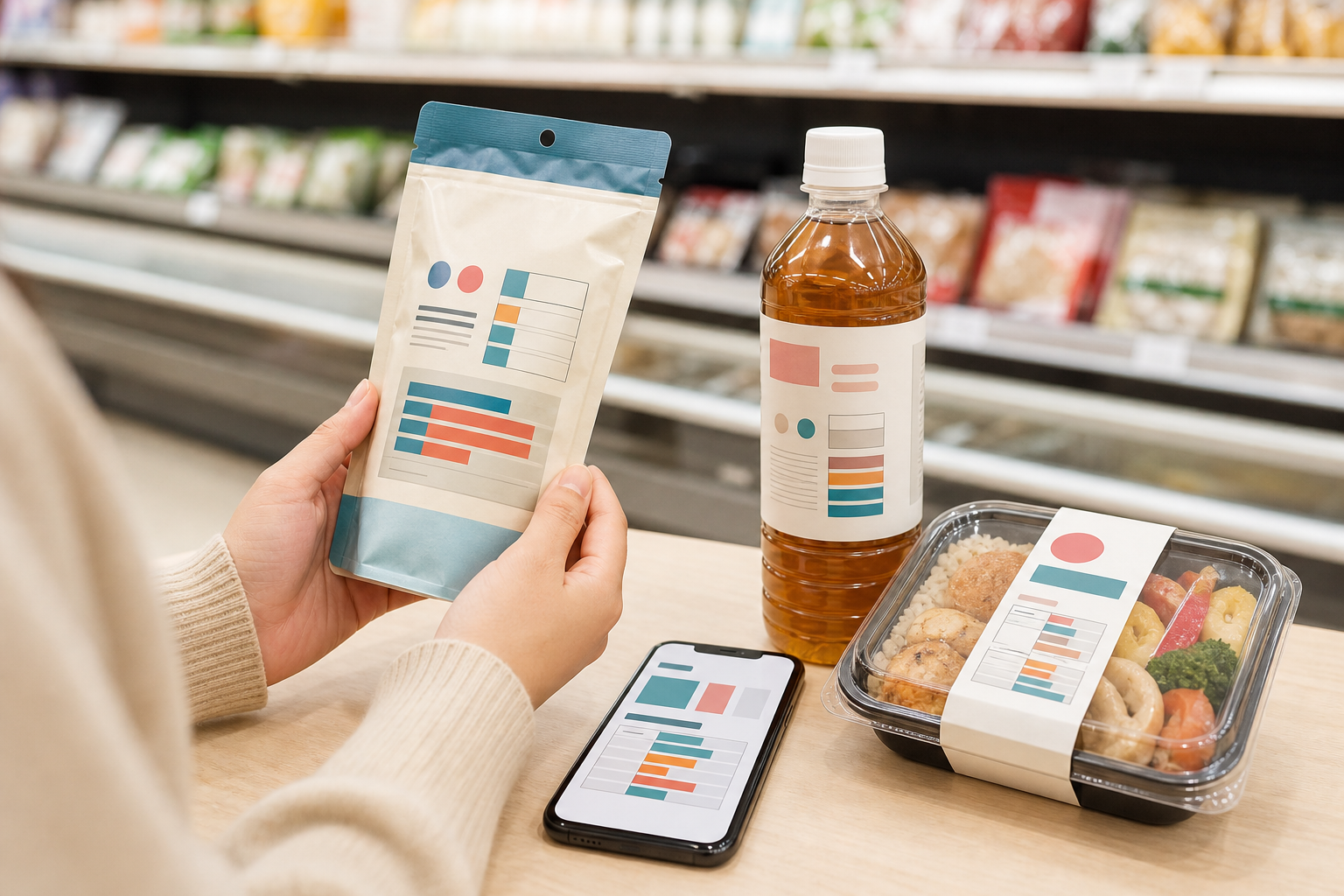
The biggest number trap on a Japanese food package is usually not the calorie figure. It is the small line above it that says whether the table covers 100g, one serving or the whole package. Find that reference amount first, then read the five required nutrients and calculate only if your portion differs.
Start with the amount above the table
Look for 100g当たり or 100ml当たり for per 100g or 100ml, 1食当たり for one serving, 1個当たり for one item, and 1包装当たり or 1袋当たり for one package or bag. Japanese rules allow any of these reference units, so a pouch that looks like one snack is not automatically one labelled serving.
Also find the net weight or volume elsewhere on the package. If a 150g bag gives values per 100g and you expect to eat it all, multiply every figure by 1.5. If you eat half, multiply by 0.75. The stated serving is a calculation basis, not personal dietary advice.
Recognize the five required lines
The standard order is 熱量 or エネルギー for energy, たんぱく質 for protein, 脂質 for fat, 炭水化物 for carbohydrate and 食塩相当量 for salt equivalent. Energy is commonly shown in kcal. Australian and New Zealand panels give energy in kilojoules, so multiply by 4.184: 200 kcal is about 837 kJ. Fibre, sugars, saturated fat, vitamins and minerals may appear too, but they are not all mandatory on every ordinary packaged food.
Do not assume 炭水化物 means sugar. It is the broader carbohydrate figure. A separate 糖質 or 糖類 line is voluntary in many cases, so its absence does not mean the product contains no sugar.
Salt equivalent is not sodium in grams
Japan normally labels sodium as 食塩相当量, the equivalent amount of salt in grams. It is not a gram figure for sodium itself. How that feels depends on the label you grew up with. A US Nutrition Facts panel counts sodium in milligrams, and Australian and New Zealand panels also list sodium, so the Japanese figure is a different quantity and needs converting before you compare. UK labels already declare salt in grams, so 食塩相当量 reads the same way as the salt line at home.
When you genuinely need a comparison, the official conversion is sodium in mg × 2.54 ÷ 1,000 ≈ salt equivalent in g. Reversing it gives approximate sodium in mg: salt equivalent in g × 1,000 ÷ 2.54. Use the label's stated salt figure directly when both products use the same basis.
Compare products on the same basis
Two tables are comparable only after their reference amounts match. Convert both to the whole pack when deciding what you will actually consume, or convert both to 100g or 100ml when comparing products with different package sizes.
Dry noodles, rice products or concentrates may show values for the product as sold and may also show prepared values. Check whether sauce, soup powder or added ingredients are included. A camera translator can help identify the terms, while Ikura Cart can scan the price tag and keep the item in a shopping total. It does not provide dietary or medical advice.
FAQ
Are calories on Japanese food labels for the whole package?
Not always. Check the line above the nutrition table. Values may be per 100g, 100ml, serving, item, bag or whole package.
What does 食塩相当量 mean?
It means salt equivalent, normally shown in grams. It is calculated from sodium and should not be read as grams of sodium.
Does 炭水化物 mean sugar?
No. 炭水化物 is total carbohydrate. 糖質 and 糖類 are narrower figures and may be shown voluntarily, so they can be absent.
How do I calculate a 150g bag labelled per 100g?
Multiply each per-100g figure by 1.5 for the whole bag. Multiply by 0.75 if you eat half of that 150g bag.
Official sources
- Consumer Affairs Agency: Nutrition Information Labels
- Consumer Affairs Agency: Nutrition Information Label in English
- Consumer Affairs Agency: Food Labelling
- e-Gov: Food Labelling Standards
- Tokyo Metropolitan Government: Nutrition Label Format
- Ministry of Agriculture, Forestry and Fisheries: Understanding Food Labels
- Ministry of Health, Labour and Welfare: Reading Nutrition Labels
- JETRO: Nutrition and Energy Labelling in Japan
- Hong Kong Centre for Food Safety: Nutrition Label Worksheet
- Taiwan Ministry of Health and Welfare: How to Read Nutrition Labels
- US FDA: Sodium in Your Diet
- GOV.UK: Nutrition labelling guidance
- Food Standards Australia New Zealand: Nutrition information panels