 Ikura Cart
How to Read Japanese Clothing Care Labels
Updated 2026-09-14
Reviewed 2026-09-14
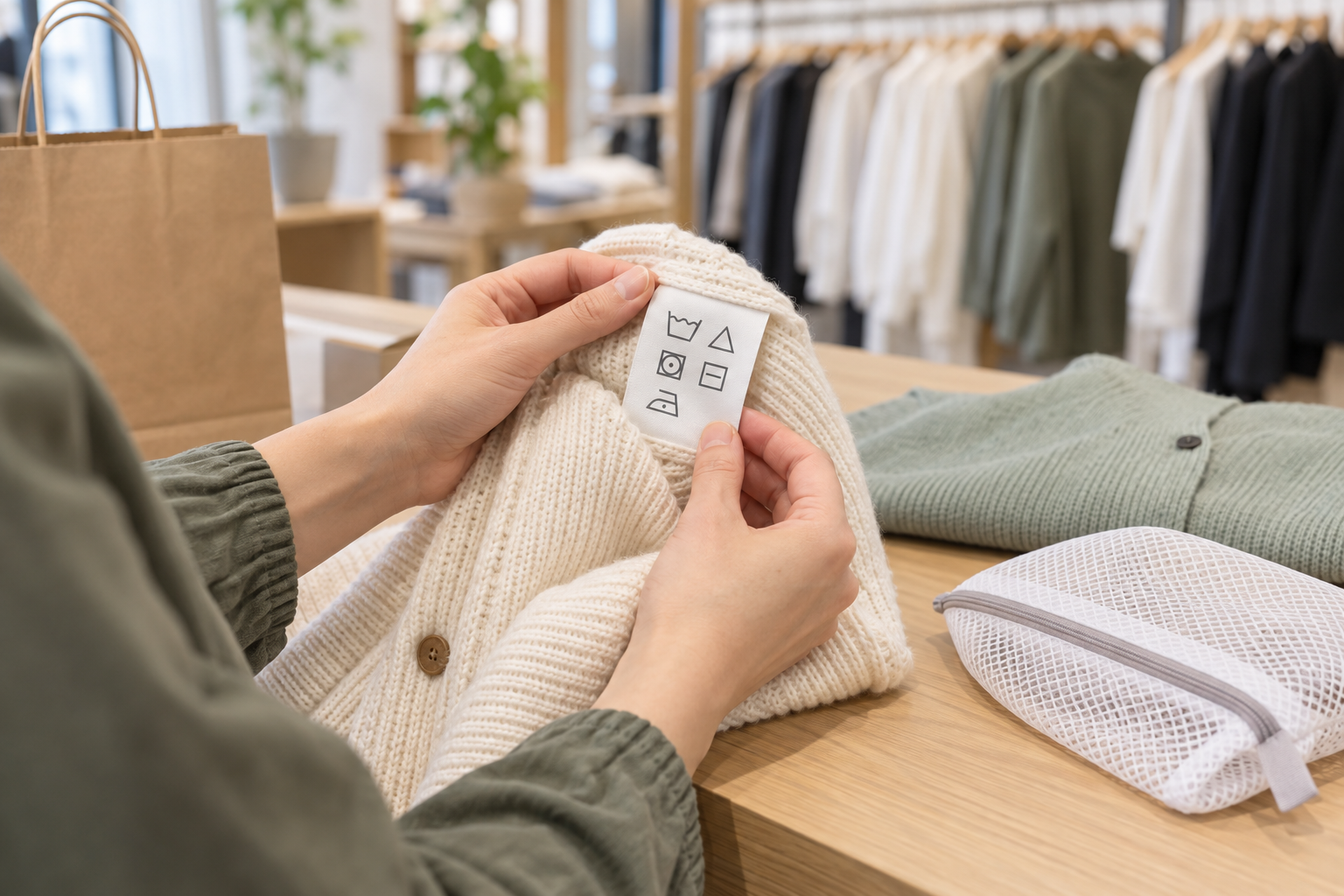
A care label can tell you more about a Japanese garment than the fabric name alone. Read the symbols as limits: the wash tub, triangle, square, iron and circle show the strongest treatment the item is designed to withstand. The Japanese note beside them may add instructions that the icons cannot express.
Start with the five symbol families
The usual order is washing, bleaching, drying, ironing, then professional cleaning. A tub is home washing, a triangle is bleach, a square is drying, an iron is ironing, and a circle is professional care. A cross means the treatment is prohibited. Do not read a crossed triangle as no tumble drying: tumble drying is shown by a circle inside a square.
Numbers inside the tub are maximum wash-liquid temperatures in Celsius, not a required setting. One or two bars below a symbol call for gentler mechanical treatment. Dots in a tumble-dry or iron symbol indicate heat level. Choose a method no stronger or hotter than the label permits.
Separate home drying from professional cleaning
A square with a circle covers a household tumble dryer. One dot means low heat and two dots mean high heat; a cross prohibits tumble drying. A plain square with lines describes natural drying. Vertical lines mean hang or drip drying, horizontal lines mean drying flat, and a diagonal mark in the corner means shade.
A plain circle does not mean a home washing cycle. Letters such as P or F inside it give solvent limits to a professional cleaner, while W refers to professional wet cleaning. If the tub is crossed out but a professional-cleaning circle is allowed, do not assume a hotel's washer on a delicate setting is equivalent.
Check whether the tag is current or old
Japan aligned its care labels with international symbols in December 2016 and revised JIS L 0001 again on 20 August 2024. The current set adds a 30°C hand-wash symbol and a low-temperature iron symbol that specifically prohibits steam. Current iron ceilings are 120°C, 160°C and 210°C, so an older chart showing 110°C, 150°C and 200°C should not be applied blindly to a new tag.
Vintage and second-hand clothing may still carry the pre-2016 Japanese set, with words such as 手洗イ, ドライ or エンソサラシ inside the shapes. Identify the label era before decoding it. Current garments can also include optional Japanese notes beside the icons, such as 洗濯ネット使用 for use a laundry net, 裏返し for turn inside out, or あて布使用 for use a pressing cloth.
Use the label before buying, not only before washing
Check the sewn-in label while you can still compare items. A coat that prohibits home washing, tumble drying and wet cleaning may require a cleaner able to follow its permitted solvent symbol. Decorative parts, coatings and linings can make two garments with the same headline fibre need different care, so the exact item's label wins over a general fabric rule.
Photograph both the symbols and the Japanese notes before removing any tag. Translation or image recognition can help, but verify an uncertain result against the Consumer Affairs Agency chart or ask a cleaner. Ikura Cart can help identify Japanese product wording and compare the price while shopping; it should not override the manufacturer's care limits.
FAQ
Does 40 in a Japanese wash symbol mean I must use 40°C water?
No. It is the maximum wash-liquid temperature. You may use a cooler method provided the rest of the treatment is no stronger than the label permits.
Is a crossed circle the same as no tumble drying?
No. A crossed plain circle prohibits the specified professional cleaning. No tumble drying is a crossed circle inside a square.
Why does an old Japanese tag have words inside the symbols?
It may use Japan's pre-December 2016 system. Identify it as an old label and use the official legacy chart instead of assigning current-symbol meanings.
What changed in Japanese laundry symbols in 2024?
JIS L 0001:2024 added a 30°C hand-wash symbol and a 120°C no-steam iron symbol, adjusted iron temperature limits, and made small shape revisions.
Official sources
- Consumer Affairs Agency: Current Laundry Care Symbols
- Consumer Affairs Agency: Laundry Symbol Resources
- Consumer Affairs Agency: Textile Product FAQ
- Consumer Affairs Agency: Textile Product Quality Labelling Rules
- Consumer Affairs Agency: JIS L 0001:2024 Revision Guide
- Consumer Affairs Agency: Household Goods Quality Labelling Act
- Japanese Standards Association: JIS L 0001:2024 Preview
- KAKEN: JIS L 0001:2024 Care Label Revision
- Sanyo Shokai: Care Labels in English
- Sanyo Shokai: Care Instructions in English